
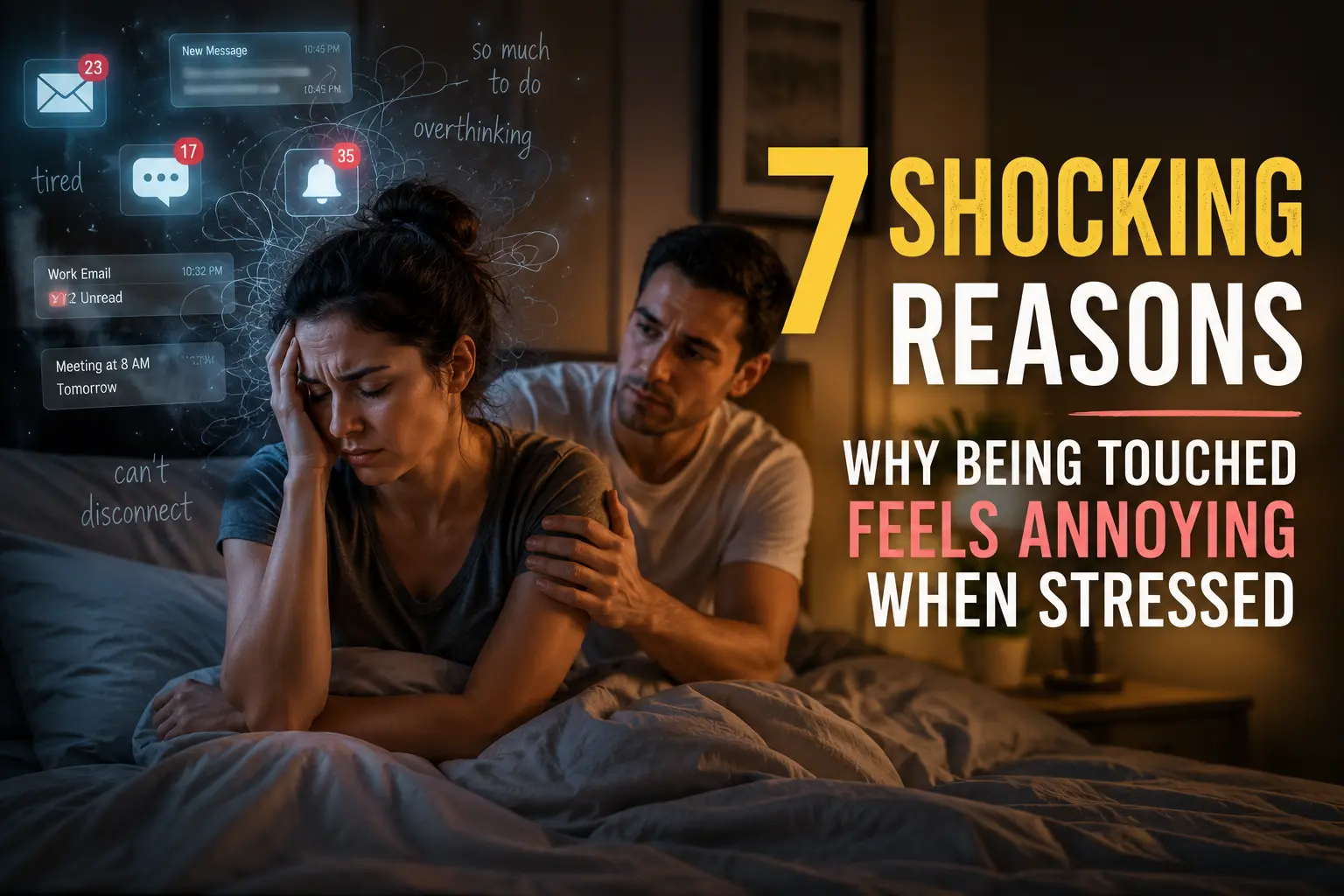
Have you ever had one of those days where everything feels like too much?
Your phone won’t stop buzzing. Emails keep coming. Work deadlines are piling up. Maybe the kids are demanding attention. Maybe you’re scrolling social media while simultaneously worrying about tomorrow.
Then your partner reaches over and gently touches your arm.
And instead of feeling comforted…
You feel irritated.
You pull away.
You don’t want to be touched.
If this sounds familiar, you’re not alone.
In fact, one thing I’ve noticed from countless conversations about relationships and intimacy is that many people quietly wonder whether something is wrong with them when physical affection suddenly feels annoying. They love their partner. They’re still attracted to them. Yet a simple hug, cuddle, or touch can feel overwhelming.
The good news?
This experience is often not about love, attraction, or relationship problems.
It’s about your nervous system.
And once you understand the science behind why being touched feels annoying when stressed, everything starts to make a lot more sense.
Table of Contents
The Symptom Nobody Talks About
Let’s paint a familiar picture.
You finally crawl into bed after a long day.
Your brain is still replaying conversations from work.
You’re thinking about bills.
You’re remembering that email you forgot to answer.
Your phone notifications are still tempting you.
Then your partner cuddles closer.
Instead of feeling relaxed, your muscles tighten.
The touch feels distracting.
Almost demanding.
You feel guilty because you know they’re simply trying to connect.
But your body reacts as if one more sensory input is the last thing you can handle.
Here’s the important part:
This doesn’t mean you’ve stopped loving your partner.
It usually means your nervous system has reached capacity.
The Discovery: Your Brain’s Filter System May Be Overloaded
Modern life bombards us with information.
Notifications.
Texts.
Videos.
Emails.
Background noise.
Breaking news.
Social media feeds.
Our brains weren’t designed to process this endless stream of stimulation.
Scientists refer to one protective mechanism as sensory gating.
Think of sensory gating as your brain’s spam filter.
Its job is to block out irrelevant information so you can focus on what matters.
Without it, every sound, touch, smell, light, and distraction would compete for your attention at the same time.
Research on auditory evoked responses and sensory gating suggests that chronic stress can weaken this filtering system. When that happens, the brain becomes less efficient at screening out unnecessary stimuli.
In simple terms?
Everything feels louder.
Everything feels brighter.
Everything feels more irritating.
And yes…
Everything feels more touch-sensitive.
This helps explain why being touched feels annoying when stressed even when the touch itself is loving and gentle.
Your nervous system isn’t rejecting your partner.
It’s struggling to process one more thing.
Your Brain Isn’t Being Difficult—It’s Being Protective
Imagine trying to have a conversation in a room where:
- Five televisions are playing
- Three people are talking
- Music is blasting
- Notifications keep going off
You’d probably feel exhausted.
Now imagine your brain experiencing a similar overload internally.
That’s what many people experience after a day of continuous stress.
The nervous system shifts into protection mode.
Instead of welcoming additional sensory input, it starts treating new sensations as potential demands.
Unfortunately, affectionate touch becomes one of those sensations.
The Role of Hypervigilance: Your Brain on High Alert
Another fascinating piece of the puzzle involves something called hypervigilance.
Hypervigilance occurs when the brain remains on constant alert.
Historically, this response helped humans survive threats.
Today, however, the “threats” often look different:
- Work pressure
- Financial worries
- Constant notifications
- Relationship stress
- Information overload
Neuroimaging research suggests that chronic stress can increase activity in what’s known as the Salience Network, particularly areas such as the insula and amygdala.
These regions help determine what deserves your attention.
When they’re constantly activated, your brain becomes highly sensitive to incoming information.
Everything feels important.
Everything demands attention.
Nothing gets filtered out.
As a result, your nervous system remains stuck in fight-or-flight mode.
The problem?
Intimacy requires the opposite state.
Pleasure, relaxation, affection, and intimate connection depend heavily on the parasympathetic nervous system—often called the “rest-and-digest” system.
When your body stays trapped in high-alert mode, even a gentle touch can feel like another task on your to-do list.
Why Being Touched Feels Annoying When Stressed During Intimacy
This is where many couples become confused.
They assume a lack of desire is causing the issue.
But often the problem starts much earlier.
According to neuroscience frameworks examining brain chemistry during physical arousal, healthy intimacy requires a process called attentional narrowing.
One key neurochemical involved is norepinephrine.
In balanced amounts, norepinephrine helps your attention focus on one experience.
Your partner’s scent.
Their voice.
Their touch.
Their presence.
The outside world fades away.
You become immersed in the moment.
But chronic stress disrupts this process.
Instead of narrowing attention, your brain stays scattered.
You’re thinking about work while kissing.
You’re remembering tomorrow’s meeting during foreplay.
You’re mentally writing grocery lists while trying to relax.
Sound familiar?
I’ve found that many people describe this feeling as “being physically present but mentally somewhere else.”
That’s not a relationship failure.
It’s an attention-regulation challenge driven by stress.
The Surprising Connection Between Digital Burnout and Touch Sensitivity
Let’s be real.
Most of us spend hours staring at screens.
Phone.
Laptop.
Tablet.
Smartwatch.
TV.
And then we wonder why our brains feel exhausted.
Digital overstimulation creates a nonstop stream of information competing for our attention.
Researchers studying sensory processing increasingly recognize that excessive stimulation can reduce the brain’s ability to transition smoothly into relaxation states.
One thing I noticed personally after long workdays is that even harmless interruptions feel magnified.
A simple question can feel annoying.
Background noise feels louder.
And physical touch doesn’t always feel comforting right away.
The issue isn’t the touch itself.
The issue is that your nervous system hasn’t had a chance to recover.
This is one of the biggest reasons why being touched feels annoying when stressed in modern relationships.
When Touch Starts Feeling Like Sensory Overload
Clinical sensory processing frameworks offer another explanation.
Human touch isn’t a single sensation.
It involves multiple systems simultaneously:
- Tactile processing (physical touch)
- Proprioception (body awareness)
- Interoception (internal sensations)
- Temperature perception
- Emotional interpretation
Normally, these systems work together beautifully.
But when stress levels are high, they can become overwhelmed.
A warm hand might suddenly feel too hot.
A blanket might feel irritating.
A cuddle might feel restrictive.
Even small changes in texture, sound, lighting, or temperature can feel amplified.
This doesn’t mean you’re broken.
It means your sensory threshold has temporarily been exceeded.
The Difference Between Not Wanting Touch and Not Loving Your Partner
This distinction matters.
A lot.
Many couples accidentally create relationship problems because they misunderstand what is happening.
One partner thinks:
“They don’t want me anymore.”
The stressed partner thinks:
“I just need space.”
Neither person is necessarily wrong.
But both may be interpreting the situation through an emotional lens rather than a neurological one.
Stress-related touch aversion is often temporary.
The desire for connection still exists.
The nervous system simply isn’t ready to receive additional stimulation.
Understanding this can remove a tremendous amount of guilt and resentment from relationships.

The Lab Experiment: A Sensory Decompression Protocol
Now for the practical part.
How do you help your nervous system become receptive again?
Think of this as a “Sensory Decompression Protocol.”
The goal isn’t forcing intimacy.
The goal is helping the brain feel safe enough to relax.
Step 1: Create a Low-Stimulation Environment
Reduce sensory demands.
Dim harsh lights.
Silence notifications.
Turn off unnecessary screens.
Lower background noise.
The fewer inputs your brain processes, the easier it becomes to recover.
Step 2: Use Brown Noise or Calming Background Audio
Some people find brown noise particularly helpful.
Unlike sudden sounds, brown noise creates a consistent auditory environment.
This may help reduce the brain’s tendency to scan constantly for new stimuli.
Apps like Calm or Headspace can also be useful.
Step 3: Practice Synchronized Breathing
Sit together.
Breathe slowly.
Match each other’s rhythm.
Even five minutes can help shift the nervous system away from fight-or-flight mode.
Research consistently shows that slow breathing supports parasympathetic activation.
And that’s exactly what intimacy needs.
Step 4: Remove Performance Pressure
This is huge.
Intimacy researchers Masters and Johnson developed a technique called Sensate Focus.
The idea is simple:
Temporarily remove expectations around physical performance.
No pressure.
No goals.
No requirement to become aroused.
Just gentle, mindful touch.
Ironically, removing pressure often makes touch enjoyable again.
Step 5: Reintroduce Touch Gradually
Start small.
A hand on the shoulder.
Holding hands.
A brief hug.
A forehead kiss.
Let your nervous system rebuild positive associations with touch.
Think of it as recalibrating rather than forcing.
When Should You Seek Professional Help?
Occasional stress-related touch sensitivity is completely normal.
However, consider speaking with a healthcare professional or therapist if:
- Touch aversion becomes persistent
- Symptoms interfere significantly with relationships
- Anxiety feels overwhelming
- Stress never seems to decrease
- Physical affection consistently causes distress
Mental health professionals, relationship therapists, and sensory processing specialists can provide valuable guidance.
It’s Not About Love—It’s About Capacity
If there’s one thing I hope you take away from this article, it’s this:
The answer to why being touched feels annoying when stressed often has very little to do with love, attraction, or relationship satisfaction.
More often, it’s your nervous system waving a white flag.
It’s a brain that has processed too much information.
A body stuck in high-alert mode.
A sensory system asking for recovery time.
And honestly?
That’s incredibly human.
The solution isn’t forcing yourself to enjoy touch.
The solution is helping your brain feel safe enough to receive it again.
When stress decreases, sensory overload settles, and your nervous system shifts back into rest-and-digest mode, touch often becomes what it was meant to be:
Comforting.
Connecting.
And deeply pleasurable.


