
There’s a conversation happening quietly in women’s group chats, private Reddit threads, and late-night talks between partners. It usually starts with a deep sigh and a frustrating question: “Where did my sex drive go?”
For years, the wellness industry has given the same copy-paste answers: check your hormones, try a generic herbal supplement, switch birth control, or just “set the mood” with some candles. But what if your hormones are fine? What if you love your partner, your stress is manageable, and the physical spark still refuses to light up?
It’s exhausting, and it makes a lot of people feel broken. But a new scientific framework out of the University of Toronto Mississauga is flipping the script on how we understand low sex drive. It suggests adult desire isn’t broken at all — it might simply be running a psychological script it learned years ago.
Table of Contents
What Exactly Is the Biodevelopmental Learning Model?
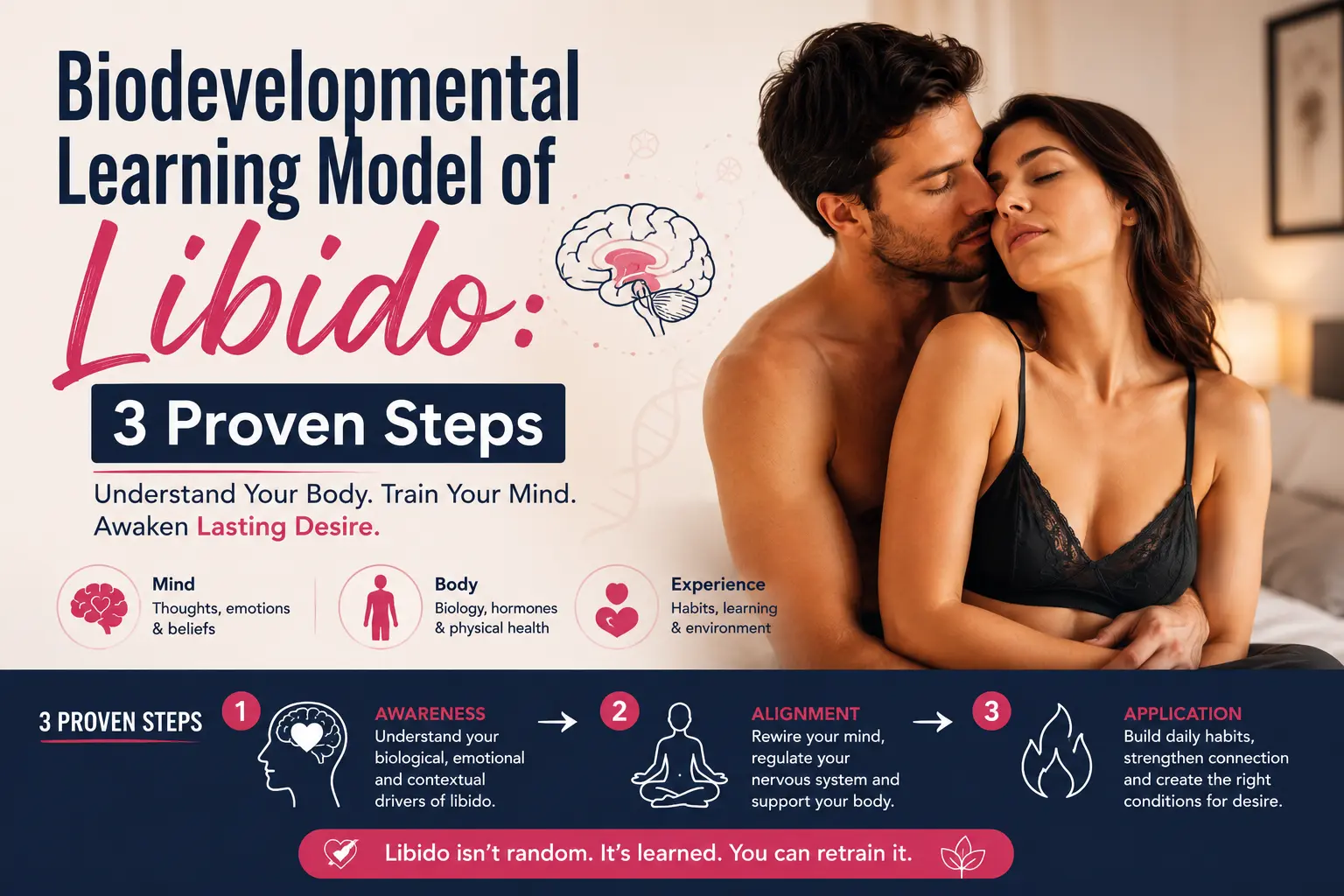
Researchers Diana Peragine, Emily Impett, and Doug VanderLaan at UTM recently introduced what they call the Biodevelopmental Learning Opportunities and Outcomes Model (BLOOM) — often shortened to the biodevelopmental learning model of libido. After reviewing more than 300 studies spanning psychology and public health, the team proposed that the long-assumed “intimacy gap” between men and women isn’t rooted in evolution or hormones at all. It’s rooted in unequal early experience.
The model treats libido as a developmental, learned trait. During “emerging adulthood” — roughly ages 16 to 25 — the brain goes through a major stretch of neuroplasticity, actively building blueprints for how to navigate adult life, including intimacy.
When someone starts having sexual experiences during these formative years, the brain isn’t just registering physical sensation. It’s logging data: Is this safe? Is this rewarding? Is this worth the energy? If those early experiences are consistently stressful, unfulfilling, or uncomfortable, the brain builds a blueprint that links intimacy with low reward. Years later, the adult brain simply executes that blueprint by turning desire down.
The core idea: low libido might not be a biological malfunction. It could be an automated, protective response the brain learned during its most sensitive developmental window — which is part of why so many people report feeling mentally turned on but not physically in the moment.
The Neurobiology of Desire: How the Brain Logs Pleasure
The brain relies heavily on dopamine to motivate wanting. Dopamine is the neurotransmitter of anticipation — the spike that shows up before a reward, not just during it. When we anticipate genuine pleasure, dopamine rises and desire follows.
But what happens when someone’s early sexual encounters are shaped by what researchers call the “pleasure gap”? Demographic research on intimacy has repeatedly found that young women in heterosexual relationships are far less likely to experience physical climax during casual or early encounters than young men are, often due to communication gaps, performance pressure, or a narrow, intercourse-focused script for intimacy.
When someone repeatedly has intimate experiences that don’t feel genuinely satisfying, the brain’s reward system doesn’t light up the way it should. Instead, the amygdala — the brain’s threat detector — can take over in response to anxiety or discomfort. Over time, those wires in a lesson: sex costs a lot of emotional and physical energy but pays out very little. Years later, the adult brain recalls that lesson and quietly keeps libido turned down to save you the frustration. It’s a protective mechanism, not a broken one — and it’s a big part of why people can feel disconnected during intimacy even in a relationship they genuinely want to be in.
How the “Pleasure Gap” Shapes Adult Desire
Most people enter their sexual lives with very little real guidance on how pleasure actually works — just awkward internet searches, vague health class warnings, or adult content, none of which teach mutual, communicative intimacy.
As a result, many women spend their formative years engaging in what clinicians call compliant touch: participating in intimacy not due to active desire, but to please a partner, fit in, or avoid an awkward moment. When early sexual history is full of compliant touch, the brain learns to file intimacy under “performance” or “chore” rather than “source of personal nourishment.”
| Aspect | High-Reward Blueprint | Learned Low-Desire Blueprint |
|---|---|---|
| Early experience focus | Mutual satisfaction, open communication, somatic comfort | Performance pressure, compliant touch, high anxiety |
| Neurological pathway | Dopamine spike → active anticipation | Amygdala activation → protective avoidance |
| Adult libido outcome | Spontaneous or responsive connection comes naturally | Brain actively dampens desire to avoid low-reward tasks |
If those early years reinforced the right-hand column, it’s entirely logical that an adult brain wouldn’t naturally crave intimacy — and no over-the-counter libido gummy fixes a learned neurological pattern. This is also why desire so often shifts and resettles across a lifetime; it’s worth reading how desire changes with age if you want the fuller picture beyond these early-adulthood years.
Unlearning the Script: 3 Steps to Rewire Your Drive
The same neuroplasticity that lets the brain learn low-reward lessons early on also lets it learn new ones later. Rewriting the blueprint takes intentional, low-pressure practice rather than a quick fix.

1. Shift From “Performance” to Somatic Presence
If your brain learned to link sex with performance anxiety, strip performance out of the equation entirely. A well-established clinical approach here is the Sensate Focus technique, developed by pioneers of clinical sexology. Instead of moving straight into intercourse, partners spend dedicated sessions on tactile, non-sexual touch — hands, back, shoulders — with zero expectation of physical arousal or climax. This teaches the nervous system that physical closeness is safe and entirely within your control. Our guide to non-penetrative intimacy is a good starting point if this kind of touch-first approach is new to you.
Because these sessions are about unhurried, skin-to-skin comfort rather than a destination, a good glide matters more than people expect — friction is one of the fastest ways to turn “safe touch” back into “something to get through.” A water-based option like JO H2O Cool Lubricant or a longer-lasting formula like Eden’s Ultra Lubricant can help take the physical friction out of the equation, so your nervous system has one less thing to brace against.
2. Practice Mindful Arousal Reframing
When you do explore intimacy, notice your internal monologue. Are you judging your body? Worrying about how long physical responsiveness is taking? Clinicians call this “spectatoring” — mentally stepping outside your body to critique it. The moment you notice yourself spectatoring, gently anchor back to one physical sensation: warmth, breath, touch. This gives the brain the chance to actually register pleasure signals instead of static, slowly rebuilding those dopamine pathways. Understanding your own psychological triggers for arousal makes this reframing much easier, since you’re working with your own patterns instead of a generic script.
3. Redefine Your Intimate Boundaries
Breaking the cycle of compliant touch means giving yourself explicit permission to pause, redirect, or say no at any point. The brain will never file intimacy as a high reward if it feels obligated or trapped. Pick a neutral, non-intimate moment to talk this through with your partner: “I’m learning my brain associates closeness with pressure, and I want us to slow down so my body can learn this is genuinely safe.” A supportive partner will meet that openly — and it’s worth grounding the conversation in what a healthy sexual relationship actually looks like, so boundaries feel like a foundation rather than a complaint.
The Big Picture: You Are Not Broken
If there’s one thing to take from the biodevelopmental learning model of libido, it’s this: you are not biologically flawed. Your brain did exactly what it was built to do — it adapted to its early environment, dampening desire for situations that were stressful or unrewarding. That’s a survival response, not a personal failure.
Because it was learned, it can be unlearned. Removing pressure, focusing on genuine somatic pleasure, and communicating openly can gradually teach your brain a new lesson: that intimacy can be safe, rewarding, and entirely yours. If any of this has you newly curious about your own patterns rather than anxious about them, that’s a good sign — exploring that curiosity is often where the real rewiring starts. And if hormonal shifts are also part of your picture, our guide to natural ways to boost female libido after 40 covers the biological side alongside this psychological one.
Frequently Asked Questions
1. What exactly is the biodevelopmental learning model of libido?
It’s a scientific framework proposing that adult sex drive is shaped heavily by sexual learning opportunities during emerging adulthood (roughly ages 16–25). When early intimate experiences lack pleasure, create anxiety, or involve pain, the brain builds a blueprint linking intimacy to low reward, which can show up as low libido later in life.
2. Can low libido really be psychological rather than hormonal?
Yes. Hormonal shifts — thyroid changes, postpartum recovery, menopause — absolutely affect desire, but plenty of people with balanced hormones still experience low libido. In those cases, the root is often a learned neurological pattern from earlier, unfulfilling, or stressful intimate experiences rather than anything hormonal.
3. How long does it take to rewrite a learned low-desire blueprint?
There’s no overnight fix, since neural pathways take time to reshape. That said, consistent practice with low-pressure touch (like Sensate Focus), mindfulness around spectatoring, and cutting out compliant touch tends to produce a noticeable shift in responsive desire within a few months for many people.
4. Does this model apply to all genders?
The research highlights women in particular because of how pronounced the pleasure gap is in early heterosexual encounters, but the underlying mechanism isn’t exclusive to women. Anyone who experienced early performance pressure, shame, or unrewarding intimacy can develop a learned low-libido response — and stress plays a related, well-documented role for men too; see how stress affects male intimacy for that side of the picture.
Disclaimer: This content is for educational and informational purposes only and does not constitute medical, psychological, or therapeutic advice. Always consult a licensed healthcare professional.


