
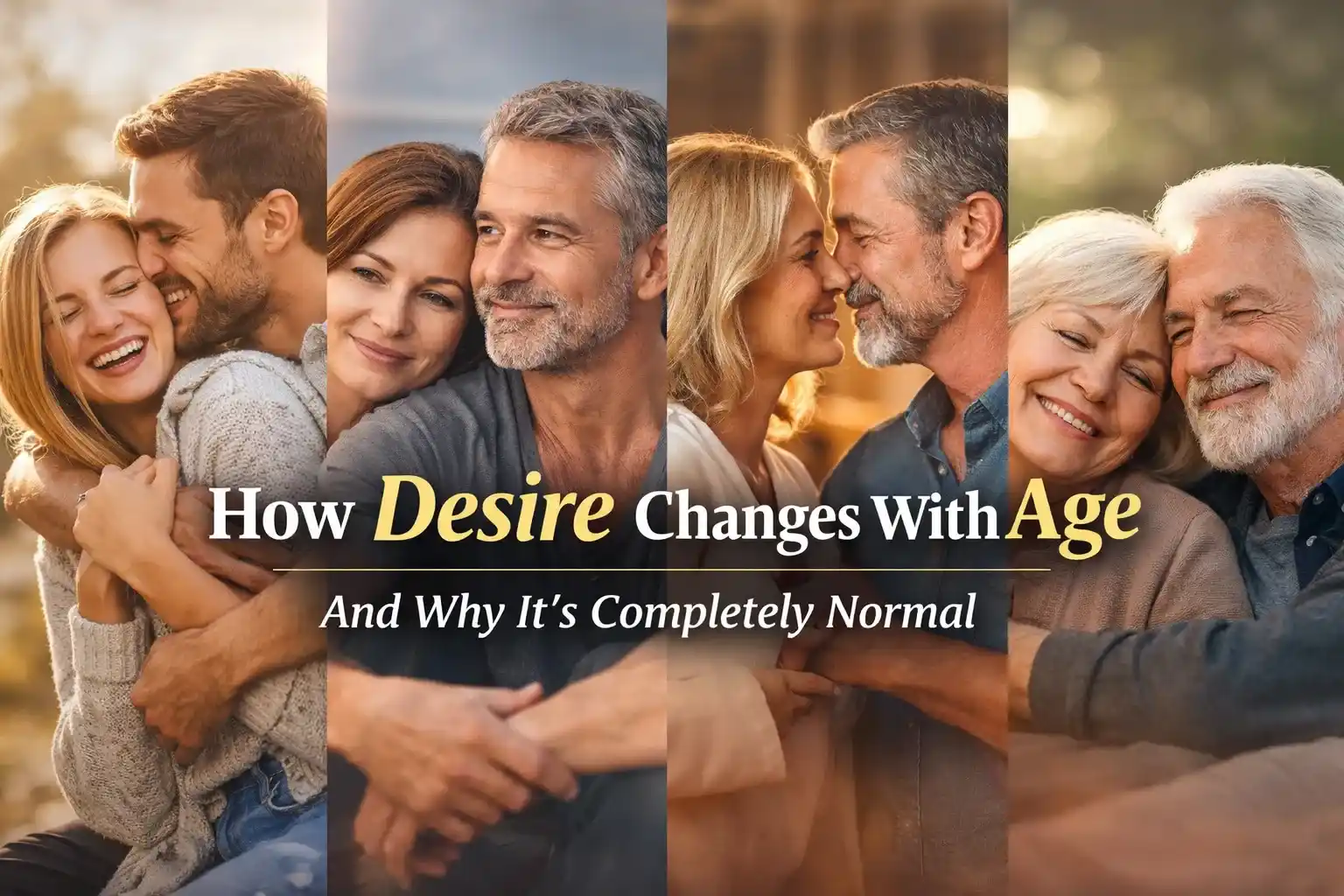
Let’s be real for a second.
Most of us grow up with this quiet assumption that desire is supposed to stay the same forever. Or worse — that if it changes, something must be “wrong.”
But in my experience? Desire changing with age isn’t a problem. It’s a pattern. A very human one.
I’ve noticed this not just in conversations with readers, friends, and couples around me — but in my own life too. The way desire felt at 22 didn’t disappear at 35 or 50. It transformed. Sometimes subtly. Sometimes dramatically.
And honestly? That shift can be confusing. Even scary.
So let’s talk about it — openly, respectfully, and without shame.
This article is a deep, honest guide on how desire changes with age, why it happens, what’s normal, and how to work with these changes instead of fighting them.
No fear-mongering. No unrealistic expectations. Just real talk.
And here’s the short version, backed by groups like the World Health Organization: sexual desire isn’t a “use it or lose it” countdown. It’s a normal part of health and well-being at every age — just expressed differently depending on your hormones, your stress levels, and what’s going on in your life right now.
Table of Contents
What Do We Really Mean by “Desire”?
Before we go any further, let’s clear something up.
Desire isn’t just about sex.
It’s about:
Wanting closeness
Feeling turned on — mentally or physically
Craving connection
Feeling confident in your body
Feeling safe enough to want someone
Desire is influenced by
So when people ask how desire changes with age, what they’re really asking is:
“Why doesn’t it feel the same as before?”
And the answer is simple — because you aren’t the same as before either.
The Big Truth: Desire Changes, But It Doesn’t Die
Let me say this clearly.
Desire does not expire with age.
What changes is:
How it shows up
What triggers it
How fast or slow it builds
What you need to feel open to it
According to guidance from global health organizations like the WHO, sexual desire is a lifelong aspect of well-being, not limited to youth. Research consistently shows that intimacy and sexual interest can remain strong well into later life — just expressed differently.
That’s huge. And reassuring.

Desire in Your Late Teens & 20s: The Fire Stage 🔥
Ah, the early years.
This is usually when desire feels:
Spontaneous
Intense
Urgent
Physical-first
In my experience, this stage often comes with curiosity mixed with insecurity. Desire might feel strong, but understanding your body? Not so much.
Hormones like testosterone and estrogen are generally at their peak here. That’s why desire can feel almost automatic — like flipping a switch.
But here’s what people don’t talk about enough:
Even at this age, desire isn’t constant.
Stress, body image issues, anxiety, breakups, and social pressure — they all affect libido. So if desire fluctuates in your 20s, that’s not failure. That’s life.
Desire in Your 30s: The Reality Check Stage ⚖️
This is where many people start Googling “how desire changes with age” for the first time.
Why?
Because life gets loud.
Careers. Bills. Parenting. Long-term relationships. Emotional baggage.
One thing I noticed was that desire didn’t disappear — it just stopped being automatic.
In your 30s:
Desire often becomes more responsive than spontaneous
Emotional safety starts mattering more
Stress becomes a major libido killer
Sex educators actually have names for that first shift: spontaneous desire (wanting sex out of nowhere) and responsive desire (desire that shows up after touch, connection, or context kicks in). Most people drift toward responsive desire as they get older — and that’s not a downgrade. It’s just a different starting point.
According to peer-reviewed research published in the U.S. National Library of Medicine, stress-related increases in cortisol levels are associated with lower sexual desire and reduced arousal responses. The study found that when cortisol levels rise — a common response to psychological stress — sexual interest and physiological arousal tend to decrease, highlighting how stress hormones can interfere with desire across adults.
So yeah — if you’re tired all the time and not in the mood, that’s biology talking. Not a personal flaw.
Desire in Your 40s: The Rewriting-the-Rules Stage ✍️
This stage surprises a lot of people.
Some feel a dip in desire. Others feel a rise. Especially when confidence improves, and self-knowledge deepens.
In my experience, people in their 40s often say:
“I know what I want now — and what I don’t.”
Hormonal shifts may begin:
Perimenopause for women
Gradual testosterone decline for men
But desire becomes less about performance and more about presence.
Slower build-up. Deeper connection. Less rush.
And honestly? That can be a total game-changer.
Desire in Your 50s and Beyond: The Depth Stage 🌊
Here’s the part society rarely celebrates — but should.
Desire after 50 can be:
Calmer
More intentional
Emotionally rich
Yes, physical changes happen. Vaginal dryness. Erectile changes. Lower spontaneous arousal.
But desire doesn’t vanish — it adapts.
Organizations like the International Society for Sexual Medicine emphasize that pleasure and desire remain accessible at any age with the right support, communication, and health care.
I’ve found that couples who thrive here are the ones who stop chasing their younger selves — and start listening to their current ones.

Why Desire Changes With Age
Let’s break it down simply — because this shift isn’t random, and it’s definitely not “all in your head.”
1. Hormonal Shifts
Hormones play a huge role in how desire shows up.
As we age, levels of hormones like estrogen, progesterone, and testosterone naturally change. That can affect:
How quickly arousal starts
How does intense desire feel?
How the body responds to touch
But here’s the reassuring part — hormonal changes don’t mean desire is gone. It just means it may need different conditions to wake up. Lifestyle factors like sleep, movement, nutrition, and stress management can help a lot. And when needed, medical guidance can make these shifts more manageable.
2. Stress & Mental Load
Desire needs mental breathing room.
As life gets fuller — work pressure, family responsibilities, financial worries — the brain stays busy. And a busy brain isn’t very receptive to pleasure.
In my experience, stress doesn’t just reduce desire; it distracts from it. You may want intimacy emotionally, but mentally feel exhausted. When stress is high, the body prioritizes survival over pleasure. That’s biology, not failure.
3. Body Image Changes
Feeling disconnected from your body can quietly dampen desire at any age.
Changes like weight fluctuation, scars, aging skin, or health conditions can affect how comfortable you feel being seen or touched. When you don’t feel at home in your body, desire often pulls back — as a form of self-protection.
Rebuilding body trust takes time, kindness, and often reframing. Desire tends to return when the body feels safe, not judged.
4. Relationship Patterns
Long-term familiarity can be comforting — but it can also reduce novelty if nothing changes.
Over time, routines settle in. Predictability grows. And while emotional safety increases, excitement may fade unless it’s intentionally refreshed.
This doesn’t mean love is weaker. It means desire now responds more to:
Emotional closeness
Intentional effort
New experiences, even small ones
Creating newness doesn’t require dramatic changes — sometimes it’s as simple as changing the setting, slowing down, or communicating needs more openly.
5. Health & Medication
Physical health matters more than many people realize.
Chronic conditions, pain, fatigue, or medications like antidepressants and blood pressure drugs can directly affect libido and arousal. This isn’t speculation — it’s well documented by medical institutions such as the Cleveland Clinic, which notes that both physical health and certain medications can significantly influence sexual desire.
If desire changes feel sudden or distressing, a medical conversation can bring clarity — and often relief.
What Helps Desire at Any Age?
Here’s what actually works — not gimmicks.
Communication (awkward but powerful)
Rest and sleep (hugely underrated)
Touch without pressure
Curiosity instead of judgment
Medical check-ins when needed
One thing I’ve found helpful is reframing desire as something you invite, not demand.
The Emotional Side Nobody Talks About
Here’s the quiet truth.
When desire changes, people often grieve their old self.
And that grief is valid.
But desire isn’t a straight line. It’s a story — with chapters.
And this chapter? It can still be meaningful. Playful. Deep.
Just different.

Practical Ways to Nurture Desire as You Age
Let’s slow this down and make it real.
These aren’t abstract ideas. They’re small mindset shifts and habits that actually work when desire doesn’t feel automatic anymore.
1. Redefine intimacy beyond intercourse
One thing I’ve noticed is that many people unknowingly tie “desire” only to sex that looks a certain way. And that’s where frustration starts.
Intimacy can be:
Cuddling without expectations
Long kisses that don’t have to lead anywhere
Massages, shared showers, holding hands in bed
Emotional closeness and feeling truly seen
When intercourse stops being the only marker of intimacy, desire often feels safer to show up. There’s less pressure. And pressure is one of the biggest desire killers.
2. Schedule intimacy
I know. Scheduling doesn’t sound sexy.
But here’s the truth — when life gets busy, waiting for spontaneous desire often means waiting forever.
Scheduling intimacy doesn’t mean forcing sex. It means:
Setting aside time for connection
Creating mental space for closeness
Telling your body, “This matters.”
In my experience, scheduled intimacy actually reduces anxiety. You’re not wondering when it’ll happen. You’re not bracing for rejection. You’re simply showing up — and letting desire build naturally.
3. Explore slower arousal styles
As we age, desire often becomes more responsive than spontaneous.
That means you might not feel “in the mood” first — but the mood arrives after touch, warmth, or emotional closeness.
Slower arousal looks like:
Taking more time with foreplay
Focusing on relaxation before stimulation
Allowing desire to unfold gradually
And honestly? Many people say this kind of desire feels deeper and more satisfying than the rushed version from earlier years.
4. Focus on sensation, not goals
When intimacy becomes goal-driven (“We must finish” or “This should lead to sex”), the body tightens up.
But when you focus on sensation — how something feels right now — desire often follows.
Try asking:
Does this touch feel good?
Do I want more of this, or less?
What feels comforting or exciting today?
Removing the finish line creates freedom. And freedom invites desire.
5. Seek professional guidance without shame
If desire changes feel distressing, confusing, or painful — you don’t have to figure it out alone.
Medical professionals, therapists, and educators trained in sexual health can help unpack:
Hormonal shifts
Medication side effects
Emotional blocks
Relationship dynamics
Organizations like the American Sexual Health Association emphasize that education, open communication, and evidence-based guidance significantly improve desire and satisfaction at every age.
Getting help isn’t a failure.
It’s self-respect.
Desire Is Not Fading — It’s Evolving
If you take one thing from this article, let it be this:
How desire changes with age is not a loss story. It’s a transformation story.
And transformations can be beautiful — if you let them.
You’re not broken.
You’re not late.
You’re not alone.
You’re human.
And desire? It’s still very much part of you.
FAQs: How Desire Changes With Age
Q1: Does desire always decrease with age?
No. Desire changes, but it doesn’t always decrease. Many people experience renewed or deeper desire later in life.
Q2: Is it normal for desire to fluctuate?
Absolutely. Stress, hormones, emotions, and health all influence how desire changes with age.
Q3: Can desire come back after a long break?
Yes. With emotional safety, curiosity, and sometimes medical support, desire can return.
Q4: How do desires change with age in long-term relationships?
Desire often becomes less spontaneous and more responsive — which is normal and workable.
Q5: Should I see a doctor if my desire changes?
If the change causes distress or feels sudden, consulting a healthcare professional is a smart step.