
Why Does Sex Hurt After Delivery? (And Why Nobody Talks About It Honestly)
Let’s be completely real for a moment. You’ve just gone through nine months of pregnancy, weathered labor and delivery, and spent weeks surviving on caffeine, broken sleep, and endless diaper changes. Then comes that standard six-week postpartum checkup. Your doctor does a brief two-minute exam, smiles warmly, and says, “Everything looks healed down there—you’re cleared for sex!” You walk out feeling a strange mix of pressure and dread. And when you finally attempt intimacy with your partner? It feels like a fiery, sharp, sandpaper-like friction that makes you want to curl into a ball and cry. If you’re quietly searching for ways to reduce pain during sex after childbirth, take a deep, grounding breath. You are 100% not alone, your body isn’t broken, and you aren’t doing anything wrong.
Here’s the unfiltered truth nobody warns new mothers about: being medically cleared for intercourse simply means your cervix has closed, lochia bleeding has stopped, and major incision stitches have dissolved so you won’t get an infection. It does not mean your hormones have rebounded, your pelvic muscles have relaxed, or your nervous system feels ready. Exploring realistic ways to reduce pain during sex after childbirth isn’t about rushing yourself to meet an arbitrary six-week calendar date. It’s about understanding what your body has actually survived, showing yourself immense grace, and taking gentle, proactive steps to restore physical comfort. In my years reviewing intimacy wellness tools and speaking with women navigating postpartum recovery, postpartum dyspareunia (the clinical term for painful intercourse) is one of the most common—yet unnecessarily hushed—realities of motherhood. Let’s pull back the curtain on why this happens and how you can genuinely heal.
The Clinical Reality: Hormones, Tissue Trauma, and the Pelvic Floor
To fix pain, we first have to understand where it comes from. Many women secretly fear that their anatomy has changed forever or that they have lost their sensual desire. In reality, postpartum discomfort is driven by a very specific trifecta of biology: hormonal plummeting, pelvic muscle hypertonicity, and tissue remodeling. Understanding the physiological roots of postpartum discomfort makes finding effective ways to reduce pain during sex after childbirth so much more intuitive.
According to a landmark multi-center longitudinal study published in Obstetrics & Gynecology (PubMed ID: 35115480) led by Dr. Natalie O. Rosen and colleagues, up to 85% of women experience dyspareunia at three months postpartum, and more than 22% to 40% continue experiencing lingering discomfort at twelve to twenty-four months. This clinical data proves without a doubt that postpartum pain is a normal physiological recovery curve, not an individual failure.
Here is what is happening behind the scenes inside your body as you explore effective ways to reduce pain during sex after childbirth:
- The Estrogen Cliff & Lactational Amenorrhea: When you deliver the placenta, your estrogen and progesterone levels drop off a cliff. If you are breastfeeding, your brain produces high levels of prolactin to support milk supply, which keeps your circulating estrogen near menopausal lows. Estrogen is responsible for vaginal blood flow, tissue elasticity, and natural lubrication. Without it, the vaginal mucosa becomes thin, delicate, and prone to micro-friction tears.
- Hypertonic Pelvic Floor (Tight, Not Just Weak): For decades, mothers were told to “do more Kegels.” But carrying a growing baby for forty weeks and pushing through birth often causes the pelvic floor muscles (the levator ani complex) to become severely spasmed and hypertonic. Just like a neck muscle that spasms after carrying a heavy backpack, tight pelvic muscles can’t stretch during penetration, causing burning or throbbing pain at the vaginal opening.
- Perineal & Incision Scar Adhesions: Whether you experienced a natural tear, an episiotomy, or a Cesarean delivery, new collagen fibers form dense, fibrous scar tissue. Fresh scars lack normal elastic fibers and can trap sensitive nerve endings, triggering sharp, localized pain upon touch.
- The Involuntary Guarding Reflex: If sex hurt the first time you tried postpartum, your sympathetic nervous system logs that memory. The next time intimacy is initiated, your brain unconsciously signals your pelvic muscles to clamp shut to protect you. This creates a vicious cycle of anticipated pain leading to involuntary tension.
5 Essential Steps: Ways to Reduce Pain During Sex After Childbirth
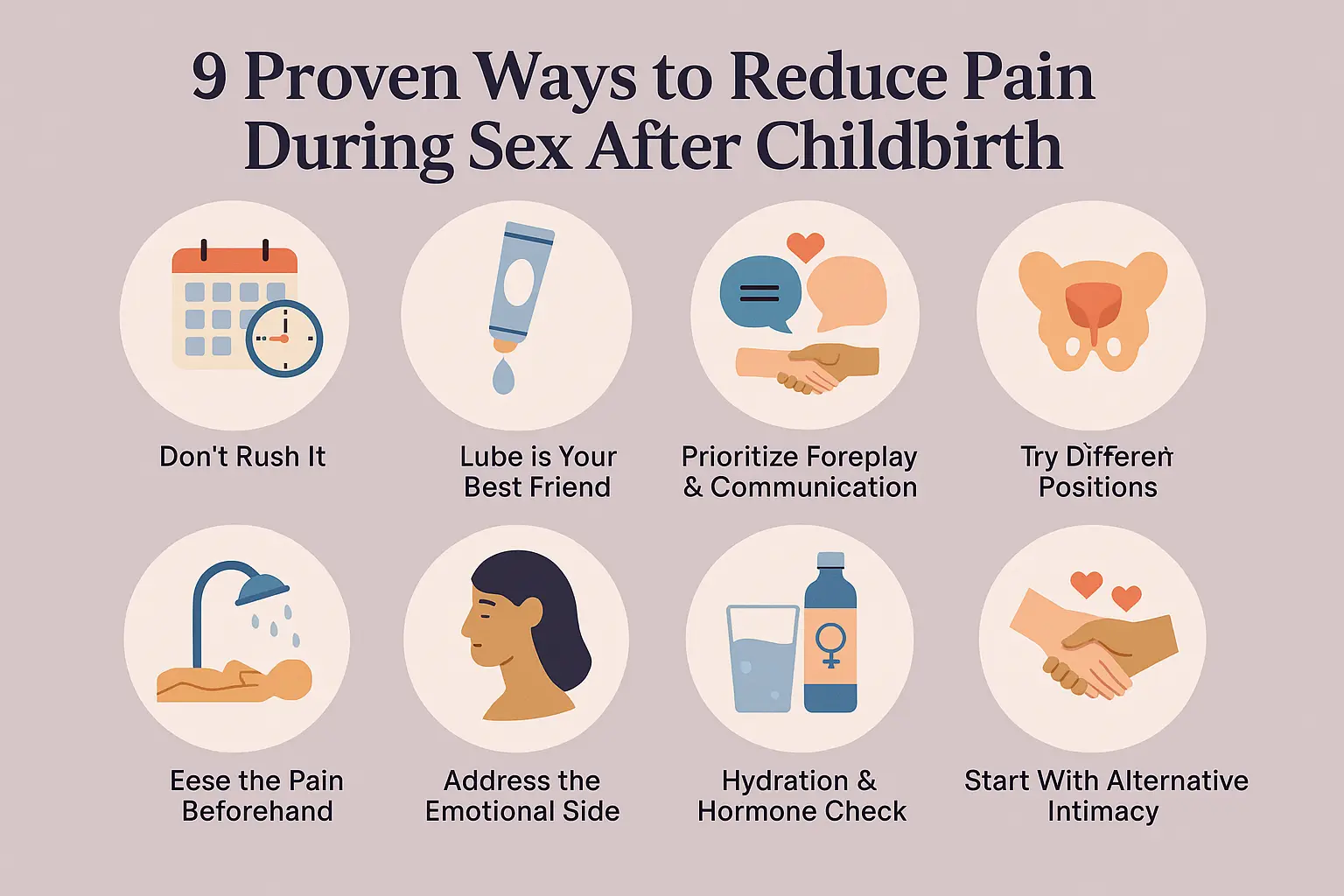
Reclaiming intimacy after having a baby isn’t an overnight flick of a switch; it is a gentle, step-by-step restoration of safety, comfort, and pleasure. When you dismantle the pressure to perform, your body naturally softens and re-learns how to receive touch without dread. To give you an empowering visual roadmap, here are the five foundational ways to reduce pain during sex after childbirth that bring relief:
- Optimize Lubrication: Switch to body-safe, iso-osmolar lubricants formulated with hyaluronic acid to restore cellular hydration and mimic natural mucosal slip.
- Pelvic Floor Down-Training: Prioritize diaphragmatic breathing and Reverse Kegels to release protective muscular spasms before ever attempting penetration.
- Gentle Scar Mobilization: Perform daily, non-painful desensitization massage on perineal or incision scars using natural body-safe oils to soften fibrous adhesions.
- Expand Erotic Play: Emphasize outercourse, sensual massage, and zero-pressure clitoral stimulation to rebuild arousal without penetrative demands.
- Angle & Depth Control: Utilize side-lying spooning or woman-on-top positioning to give you 100% control over the speed, rhythm, and depth of contact.

Let’s break down each of these steps in full, practical detail so you know exactly what to do from the comfort of your own bedroom.
Step 1: Upgrading Your Lubricant (Osmolality, pH, and Why Spit Doesn’t Cut It)
Let me shout this from the rooftops: using lube postpartum is not a sign that you aren’t turned on, and it’s certainly not a failure on your part. When you are postpartum and nursing, your hormonal profile literally prevents your Bartholin’s glands from producing their usual pre-baby lubrication. When researching practical ways to reduce pain during sex after childbirth, upgrading your bottle of lube is the single quickest, most dramatic upgrade you can make.
However, when exploring proven ways to reduce pain during sex after childbirth, grabbing whatever old, dusty bottle is sitting in your nightstand drawer can actually make things worse. Many drugstore lubricants are packed with glycerin, parabens, artificial warming additives, or high osmolality. In clinical biophysics, high-osmolality lubes pull moisture out of your delicate vaginal cells, leaving postpartum tissue parched, irritated, and burning within minutes. For sensitive postpartum recovery, you want products that match natural tissue biology:
- Iso-Osmolar Water-Based Formulas: Look for clean, glycerin-free water-based lubes with an osmolality under 380 mOsm/kg and a healthy physiological pH around 3.8 to 4.5. Trusted medical favorites include Slippery Stuff and Good Clean Love. If you want a deep dive into clean, body-safe ingredients, read our detailed recommendations in best lubricant for first-time sex.
- Silicone-Based Lubricants for Lasting Cushion: If water-based options absorb too fast or dry sticky against sensitive scars, medical-grade silicone (like Uberlube) is an absolute miracle worker. Silicone molecules are too large to be absorbed by mucosal skin, meaning they sit on the surface providing silky, frictionless glide that lasts through the entire session without reapplying.
- Hyaluronic Acid Vaginal Moisturizers: If you suffer from round-the-clock vaginal dryness, itching, or friction while walking, apply an over-the-counter hyaluronic acid vaginal moisturizer (such as Revaree) two to three nights a week. Hyaluronic acid binds up to 1,000 times its weight in water, plumping up estrogen-depleted mucosal cells from the inside out. For women with hyper-reactive vulvar skin, check out our guide on hypoallergenic lubricant for sensitive female skin.
One golden rule: never skimp on quantity. Apply a generous dollop to both your partner and directly around your vaginal opening before any contact begins.
Step 2: Pelvic Floor Down-Training (Why Kegels Might Actually Make Pain Worse)
Here is one of the most widespread, harmful postpartum myths in modern culture: the belief that every postpartum woman needs to do hundreds of Kegels to “tighten things up.” If you are experiencing pain during sex, doing Kegels is quite literally like throwing gasoline on a bonfire! When pelvic floor muscles are injured, traumatized, or exhausted from labor, they frequently contract into a tight, hypertonic defensive spasm. Clenching them further only increases muscle fatigue, causes nerve entrapment, and makes penetration feel like hitting a solid brick wall.
One of the most counter-intuitive yet essential ways to reduce pain during sex after childbirth involves retraining your pelvic floor to let go. In physical therapy, this is called ‘down-training’ or performing Reverse Kegels. Learning how to drop and lengthen your pelvic floor is one of the most transformative ways to reduce pain during sex after childbirth you will ever learn.
Here is a simple 3-step down-training routine you can practice daily in bed:
- Diaphragmatic Belly Breathing: Lie comfortably on your back with your knees bent and feet flat on the mattress (or propped on a pillow). Place one hand on your chest and one on your lower belly. Inhale deeply through your nose for a count of four, sending the breath all the way down into your pelvis. Feel your belly rise and imagine your sitz bones gently blooming open like flower petals.
- The Pelvic Drop: As you inhale, consciously visualize the muscles between your pubic bone and tailbone dropping downward and relaxing completely—similar to the subtle sensation of releasing a stream of urine. Do not push or strain; simply invite the muscles to soften. Exhale gently through your mouth without squeezing.
- Child’s Pose & Happy Baby Stretches: Spend five minutes resting in gentle yoga postures that passively stretch the pelvic bowl. In Child’s Pose, widen your knees, sink your hips back toward your heels, and let your pelvic basin expand with every breath.
Practicing five to ten minutes of diaphragmatic down-training before bedroom intimacy helps turn down your sympathetic nervous system, calming the muscular guarding reflex before touch even starts.
Step 3: Gentle Perineal and Scar Tissue Desensitization
If you experienced a perineal tear or episiotomy, scar tissue massage is among the most effective physical ways to reduce pain during sex after childbirth. When skin, muscle, and fascia knit back together after tearing or surgical incisions, the resulting scar collagen fibers are naturally disorganized, stiff, and adhered to underlying tissues. Furthermore, cutaneous nerve endings around the scar often become hyper-sensitized, firing off alarms even with light touch.
Once your healthcare provider confirms that your stitches have fully dissolved and the incision is closed (typically around 6 to 8 weeks postpartum), you can begin gentle scar tissue mobilization at home. In my experience, spending just two to three minutes every other day softens stiff adhesions and rewires your brain’s relationship with that area.
Here is how to perform gentle scar massage as one of your daily ways to reduce pain during sex after childbirth:
- Prep with Warmth and Cleanliness: Wash your hands thoroughly with mild soap. Take a warm bath beforehand or hold a warm, damp washcloth against your perineum for five minutes to increase local blood circulation and soften the tissue.
- Use a Natural, Clean Emollient: Place a drop of pure vitamin E oil, cold-pressed jojoba oil, or medical-grade lubricant on your index finger and thumb. Avoid fragranced body lotions or essential oils that can disrupt your vaginal pH balance.
- External Mobilization (Clock Technique): Gently place your index finger flat against the scar on your perineum (the space between your vaginal opening and anus). Using light, circular motions, gently roll the skin over the underlying muscle. Move in small circular strokes clockwise and counter-clockwise along the entire length of the scar line.
- Internal Stretch (The ‘U’ Technique): Insert the pad of your thumb about an inch inside your vaginal opening, resting your index finger externally on the perineum. Gently apply firm, comfortable pressure downward toward the rectum, holding for 20 to 30 seconds while practicing diaphragmatic breathing. Then slowly sweep your thumb from side to side in a gentle ‘U’ motion (from 4 o’clock to 8 o’clock).
Crucial reminder: scar desensitization should feel like a mild stretch or warmth, never sharp pain. If you feel sudden wincing, ease off your pressure. Consistency over time will restore natural elasticity to the tissue.
Step 4: Taking Penetration Off the Table (The Magic of Outercourse)
Let’s talk about psychological pressure. When you know that getting into bed with your partner inevitably leads to penetrative intercourse, and you know intercourse currently hurts, your brain registers intimacy as an impending dental appointment! You tense up, your breathing turns shallow, and you mentally disconnect. That is why taking penetration completely off the table for several weeks is pure liberation.
Broadening your erotic menu beyond vaginal intercourse is one of my personal favorite ways to reduce pain during sex after childbirth. Enter the concept of outercourse—erotic, sensual, and deeply pleasurable intimacy that involves everything except penetration. When the expectation of the ‘finish line’ is removed, your body can finally relax back into pleasure.
How to Rebuild Pleasure Without Pressure
As one of the most liberating ways to reduce pain during sex after childbirth, outercourse allows your neuro-sensory system to remember that touch feels amazing. You can explore mutual masturbation, whole-body oil massage, passionate kissing, oral intimacy, or gentle external vibration. Because the clitoris contains over 10,000 sensitive nerve endings located primarily on the outside of your vulva, you can experience deeply satisfying climaxes without touching your healing perineum or vaginal canal.
To discover more creative ways to enjoy non-penetrative pleasure, explore our full guide on outercourse and nonpenetrative sex benefits. When you’re ready to introduce shared novelty, gentle beginner devices can make exploring together feel fun and zero-pressure—take a peek at beginner couples toys women love for safe, body-safe inspirations.
Step 5: Postpartum-Friendly Sex Positions for Angle and Depth Control
When you and your partner feel genuinely ready to test the waters of penetrative intercourse, throw out the idea that you have to start with traditional missionary. In traditional missionary, your partner’s full body weight rests above you, thrusting depth is dictated by them, and the downward angle of entry places intense, direct traction right on your posterior fourchette—the exact spot where perineal tears and episiotomies are located.
Choosing anatomical angles that grant you full control over thrusting depth is one of the quickest ways to reduce pain during sex after childbirth. Testing different angles is truly one of the simplest mechanical ways to reduce pain during sex after childbirth without feeling pressured. Here are three doctor- and pelvic-physical-therapist-approved positions to try:
- Woman-on-Top (The Coital Alignment Position): Being on top gives you 100% control over the speed, rhythm, angle, and depth of entry. You can pause whenever you need, apply extra lubricant in real time, and lean forward so stimulation is centered against your clitoris rather than dragging across a tender perineal scar.
- Side-Lying / Spooning: Both of you lie comfortably on your sides curled together like spoons. This position requires zero abdominal effort from you, eliminates heavy body weight pressing on your pelvis, and naturally limits penetration depth. Because your legs remain closer together, your pelvic floor muscles stay relaxed rather than being over-stretched.
- The Propped-Pelvis Variation: If you do prefer face-to-face closeness, place a firm pillow or yoga bolster under your hips and keep your feet flat on the bed (instead of pulling your knees up to your chest). Propping your pelvis tilts your vaginal canal slightly, creating a gentler angle of entry that bypasses sensitive pelvic trigger points.
Remember: go at a snail’s pace. Use the “two steps forward, one step back” approach. If there is any burning sensation upon entry, stop immediately, add more lubricant, breathe into your pelvic floor, and switch back to non-penetrative caresses.
Rebuilding Intimacy and Navigating Bedroom Conversations Without Guilt
Let’s talk about the emotional elephant in the room: mom guilt, body dysmorphia, and ‘touch fatigue.’ After spending ten hours holding a nursing infant against your chest, being drooled on, and having someone physically attached to you all day, you might experience what psychologists call being ‘touched out.’ By 9:00 PM, the very idea of another human being touching your skin can make you want to scream! If your partner then initiates intimacy, you might feel an agonizing tug-of-war between wanting to show them love and wanting your body entirely to yourself.
Emotional safety and vocal transparency are just as critical as physical remedies when exploring ways to reduce pain during sex after childbirth. Your partner isn’t a mind reader. If you quietly grit your teeth and endure painful intercourse just to get it over with, you will unconsciously build deep romantic resentment, while reinforcing your body’s pain reflexes.
Try these conversational scripts to support your partner while putting into practice effective ways to reduce pain during sex after childbirth:
- “I love you and I miss our closeness so much, but my body is still healing physically down there. Can we spend tonight cuddling and doing a back massage with zero pressure for sex?”
- “Because of breastfeeding hormones, things are physically very dry and tender right now. I need us to go super slow and use lots of lube, and if I say pause, I need to know you won’t be frustrated.”
- “I’m feeling really touched out after holding the baby all afternoon. I need thirty minutes of quiet alone time to recharge, and then I’d love to curl up with you on the couch.”
For more actionable relationship advice on keeping passion alive amidst hectic life transitions, read our practical strategies in how to improve intimacy in a relationship, and explore our communication guide on how to talk about sexual preferences with partner dynamics without feeling awkward.
When to See a Pelvic Health Specialist (Red Flags and Medical Treatments)
While home strategies provide immense relief, partnering with medical professionals is one of the smartest ways to reduce pain during sex after childbirth if discomfort persists. We live in a society that often normalizes female suffering, treating postpartum pelvic pain as a ‘rite of passage’ that mothers just have to live with. Let me be unequivocally clear: common does not mean normal!
If you have tried conservative ways to reduce pain during sex after childbirth and intercourse still feels sharp, burning, or physically impossible after three to four months, scheduling a dedicated clinical evaluation is essential. Do not wait for your annual wellness checkup.
Here are clinical red flags that warrant specialist evaluation:
- Granulation Tissue: Occasionally, healing vaginal tears form small, hyper-vascular clusters of unhealed tissue (granulation tissue) that bleed easily and cause sharp, pinpoint burning upon touch. An OB-GYN or midwife can treat this easily in a simple office visit using a silver nitrate application.
- Severe Estrogen Atrophy (Lactational Vulvovaginitis): If your mucosal tissues are visibly pale, thin, and persistently raw, your healthcare provider can prescribe localized topical vaginal estrogen cream. Because it acts locally in the vaginal tissue with negligible systemic absorption, it is safe for breastfeeding and repairs tissue elasticity within a few weeks.
- Chronic Pelvic Floor Hypertonicity & Pudendal Neuralgia: A board-certified Pelvic Floor Physical Therapist (look for clinicians certified through the Herman & Wallace Pelvic Rehabilitation Institute or the Academy of Pelvic Health Physical Therapy) will evaluate your internal pelvic musculature, release trigger points, mobilze nerve pathways, and provide custom rehabilitation.
- Postpartum Infection Symptoms: If your pain is accompanied by unusual odor, abnormal discharge, fever, or pelvic cramping, you must rule out an infection immediately. For vital hygiene practices on keeping bedroom accessories sanitary, review our medical guide on can sex toys cause infection.
Frequently Asked Questions About Ways to Reduce Pain During Sex After Childbirth
1. How long does pain during sex after childbirth usually last?
For many women, mild sensitivity improves noticeably between 3 and 6 months postpartum as hormone levels stabilize and tissue remodeling settles. However, large clinical studies demonstrate that 20% to 40% of mothers continue experiencing pain at 12 to 24 months—especially if they are actively breastfeeding or had perineal lacerations. You do not have to wait a year to seek help; if discomfort lingers past three months, consulting a pelvic floor physical therapist can dramatically shorten your recovery time.
2. Why do tight pelvic muscles require specialized ways to reduce pain during sex after childbirth instead of standard Kegels?
While pregnancy and birth do stretch the pelvic floor, the trauma of labor frequently triggers a sustained protective muscle spasm. Think of it like your neck locking up after a whiplash injury. Because the levator ani muscles are guarding against further trauma, they become short, stiff, and hypertonic, preventing the vaginal canal from accommodating entry without pain.
3. Which lubricant ingredients should postpartum mothers avoid?
Steer clear of lubricants containing glycerin (which can feed yeast infections in hormonal postpartum flora), parabens, propylene glycol, synthetic fragrances, and artificial tingling or warming chemicals. Look for hypoallergenic, iso-osmolar water-based lubes or pure medical-grade silicone formulas with minimal, clean ingredients.
4. What are the best ways to reduce pain during sex after childbirth if I had an episiotomy or severe tear?
The most effective combination includes daily scar tissue massage with pure vitamin E oil once the incision is completely closed, consistent diaphragmatic breathing to release the pelvic floor, applying warm compresses before bedroom intimacy, and choosing positions like woman-on-top where you control the angle and depth of contact.
5. Can I use localized estrogen cream if I am actively breastfeeding?
In the vast majority of clinical cases, yes! Localized vaginal estrogen creams (such as estradiol or estriol) work directly on the mucosal receptor cells in the vaginal canal with minimal to undetectable absorption into maternal bloodstream, meaning they do not adversely affect your milk supply. Always discuss this with your OB-GYN or midwife to receive an individualized prescription.
6. Is it safe to use clitoral vibrators or sensual toys while healing postpartum?
Yes, absolutely—provided your external lochia bleeding has ceased and your incisions are closed. External clitoral stimulation completely bypasses tender vaginal walls and perineal scars, allowing you to experience pleasure, boost mood-elevating oxytocin, and increase healing blood flow without any penetrative discomfort.
Final Thoughts: Giving Your Body the Time and Grace It Deserves
At the end of the day, your body just performed the most magnificent, physically demanding athletic feat in human existence: growing, nurturing, and birthing a human being. It took forty weeks to stretch, shift bones, and create a baby; giving yourself several months or even a year to gently recalibrate your intimate life is not just reasonable—it is essential.
Embracing compassionate, science-backed ways to reduce pain during sex after childbirth allows you to reclaim your body on your own terms. Release the pressure of arbitrary deadlines, ditch the comparison with social media portrayals, and honor your healing timeline. Communicate openly with your partner, lavish yourself with quality lubricant, and remember: intimacy isn’t a finish line to cross, it is a garden to nurture together with patience, humor, and endless love.


